Matt van Heukelom
My name's Matthew Von Heukelom. I'm 30 years old, from Toronto, Ontario, Canada. I've been living in the Bay Area since 2018. I started cycling, like many others, around COVID. I had a road bike prior to COVID that I would use to commute across the city, and when all the other sports got canceled during COVID, I started riding more casually and got really into it. A huge time and money sink later, here we are.
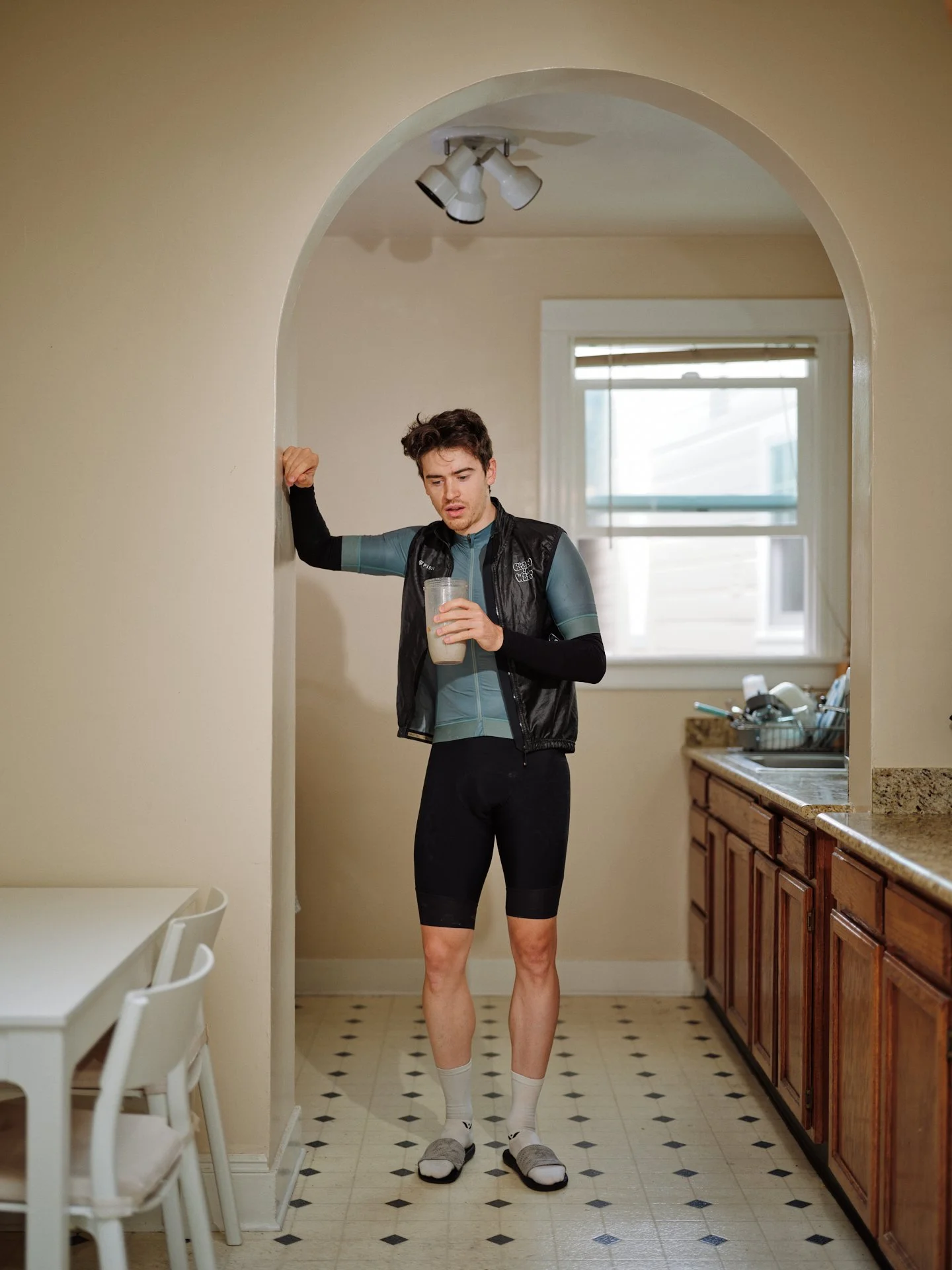
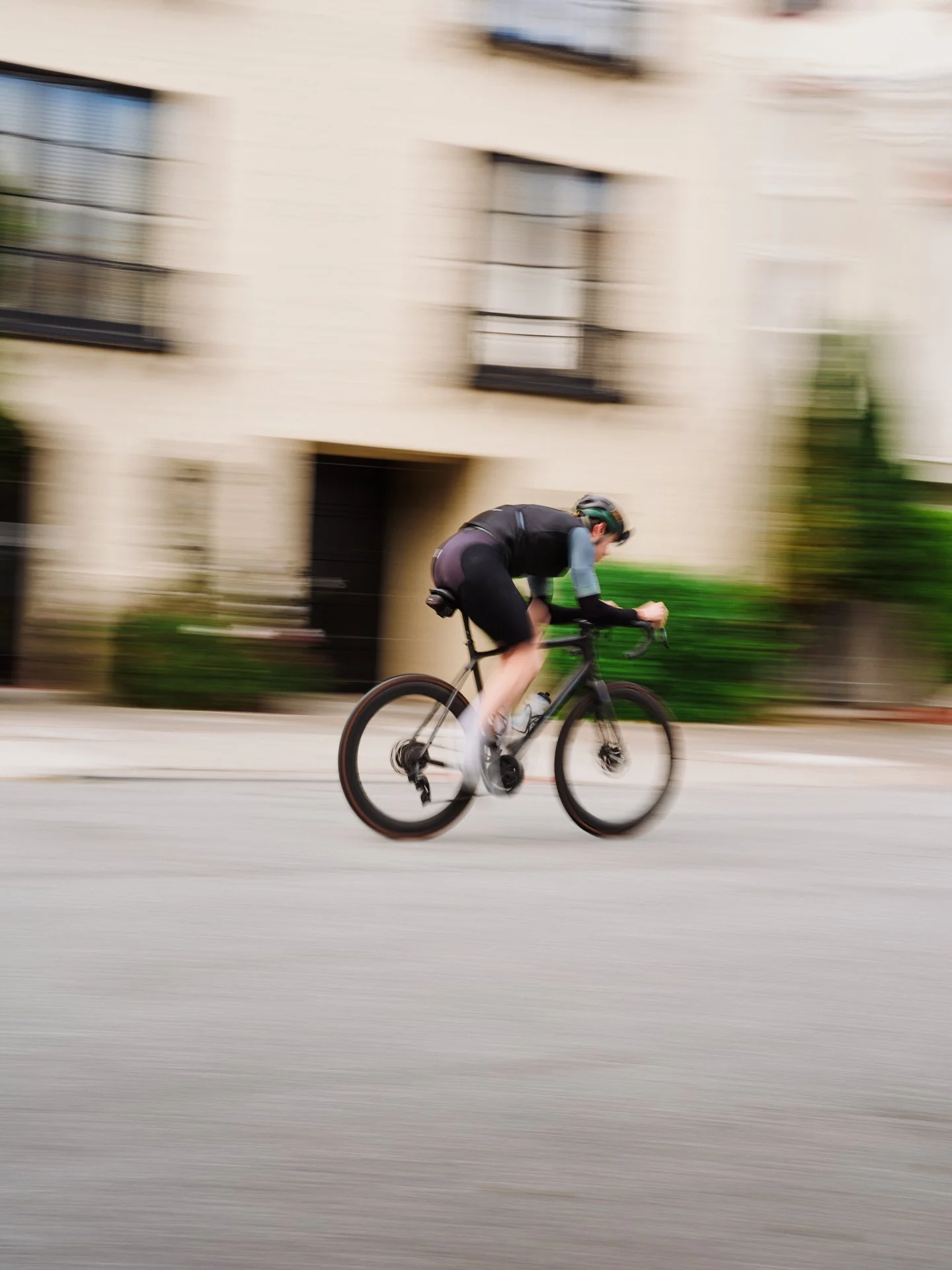
Interviewed at Flywheel Coffee on Stanyan Street, San Francisco, CA, May 5, 2026
Matthew: I was playing hockey probably three nights a week. There's one rink in the city, and I was on two teams, and would also sub for my friends on other teams. I really enjoy hockey, but the problem is that there's only one rink in the city, so a lot of the games started at like 10:45, 11 p.m. You'd wake up the next morning not feeling the best, getting to work just because it was a late night. But yeah, I was playing a lot and I really liked it. I was also playing soccer on one to two teams. So between that, I was pretty busy with sports.
During COVID, that all got canceled, and once COVID kind of resolved to some extent, I was still doing those sports, but it got dialed back quite a lot. Then I separated my AC joint playing hockey. That was probably around May 2023. From there, I had to get shoulder surgery and do a four-month rehab. When I was rehabbing — you can't play hockey, you can't play soccer, you can't bike — but you can ride on the trainer. So I was on Zwift for four months while my shoulder was healing, just getting fitness through that.
I had a lot more confidence to go do some of the faster group rides around the city. From there, I did the Pas Normal ride once my shoulder healed, and that's where I met you and Ivan. I remember you guys were just flying up McCullough to Hawk Hill, and Ivan led you out in crazy strong times. But even then, that was my first ride outside in five months, and there was lots of adrenaline going. It was really fun.
Ian: You were very strong in that too.
Yeah, because I had been training on Zwift and it was a lot easier to push the watts outside. I think I set my Hawk Hill PR on the Wednesday and then went to the Thursday Pas Normal ride. I don't know from there how I got closer to the whole Thursday group. I had already known Michael Sommers from prior to that because I'd met him at a Tuesday night park ride before I got injured. So I kind of recognized him and was friendly with him. I think I just asked Michael to ride a couple more times, and whenever Michael's riding, Ivan's there. Ivan is like the glue that holds everyone together. So yeah, definitely got closer with the group through him. He organized a lot of stuff, and it's been great so far.
So when did you first start riding road bikes — around 2020-ish?
Yeah, around COVID, right? 2020. I would do rides with one of my friends from Canada. Nothing serious — we would do Alpine Dam, Bolinas Ridge, the Stinson Loop, Mount Tam.
I mean, those are pretty robust rides.
Yeah, they're real rides, but they're not like century rides or anything like that. During COVID we would ride together every weekend, and I would try to get out for a ride after work. But once COVID kind of ended, he wanted to get more of a normal life back and not spend all his weekend energy cycling.
And you wanted to get more into cycling?
Yeah, I really enjoyed it and wanted to keep doing it. So that's kind of how it worked out. We're still friendly, but he's not interested in really riding anymore.
So when did you get serious about road biking?
I would say I got more serious when I hurt my shoulder — 2023, about two years ago. That's when I kind of went all in on Zwift when I couldn't do any other sports. Then once I got healed up, I was still playing hockey but only on one team. Really dialed back those hours and spent more time on the bike. So yeah, the second half of 2023 things have been ramping up, and then 2024 I started riding a lot more consistently.
Coming from hockey and soccer — I mean, those are both big lower-body sports, but also, I imagine in hockey there's a lot of bulk required and upper-body strength. Do you feel like you went through some sort of transformation shifting more towards cycling?
Yes, but a lot of that transformation happened with my injury. When I got injured, I wasn't really exercising. I lost maybe eight pounds or so, and I wasn't big before or anything, so a lot of that was muscle. I went from maybe average to a little bit on the skinny side. But I was never a super bulky guy, just genetically.
Hockey does translate with the leg muscles — there's a lot of quads and glutes, so that translates well to cycling. Obviously soccer, you need cardio. And I do have a bit of an endurance background from high school — I ran cross-country and did cross-country skiing. So I guess my whole life I've definitely been doing cardio sports.
As far as cycling's concerned, what does "serious" mean to you?
I mean, I'm not doing a lot of races, but I am pretty invested in the training. I don't have a coach. I tried coaching with Ivan, but to me, half of the fun is just figuring out the intervals for yourself — like what your power target should be and what you can sustain. I would say things got more serious once I was training twelve-plus hours per week, and once you start caring a bit more about the recovery side of things and the nutrition, you get more invested in that kind of stuff.
That's interesting. It's like not so much riding in the moment, but how are you gonna ride the next day and the next day and the next day?
Yeah, exactly. Not just worrying about the current route or ride, but investing in those other things — the training, the nutrition, the recovery — to be able to do it more consistently and actually get faster and stronger.
It's almost like you're writing a whole long story, and each ride is a sentence, and you have to string them together in a way that makes sense.
Yeah, for sure. I definitely like building up to the long weekend rides. That's something that definitely motivates me. I love those long Saturdays out on the bike. I've been trying to mix it up a lot the past year — we've done a lot of point-to-point loops instead of just your normal Marin loop, where we'll go to the East Bay and BART back, or go to the South Bay and Caltrain back.
I think part of why I started cycling was just to get out of the city. Back in COVID, I didn't have a car or anything, so the bike was a great way to explore the rest of the Bay Area. Maybe that's one of the reasons I originally fell in love with the sport. And then as you become a stronger cyclist, if you want to keep exploring, you have to go further and further, or maybe try certain roads that you wouldn't have been capable of before. So yeah, I really enjoy that.
In what ways does road biking impact your life?
I mean, it's a time sink every week for sure. If you want to do the training — I would like to get maybe fifteen hours a week riding bikes — that means a lot of Saturdays are dedicated to that, a lot of early morning alarms. Just trying to live a healthier lifestyle in terms of — I don't really drink so much anymore, and I try to be conscious about what I eat. There are definitely days where you're burning so many calories that you're eating more than you ever thought you would, but at least trying to make it healthy.
How many days a week do you usually ride?
Well, I haven't been riding as much recently because I had a knee injury that I'm kind of recovering from. But I think the target is fifteen hours when I'm healthy, and that would be about five days a week. One day a week I'm still playing hockey, and then a day of rest every week as well. So yeah, five days a week of cycling ideally. I'm pretty fortunate to live close to the bridge and work from home. If I can be at the bridge by 6:30, I can get a two-and-a-half-hour ride in and still be at my desk at home for 9 a.m.
Do you feel like cycling has ever negatively impacted your life?
Well, there are sacrifices to be made. My partner feels that at times. She doesn't like it when the alarm goes off at 5:45 or 6 in the morning. So yeah, there are definitely some negative consequences — that's just the sacrifices you have elsewhere in your life. The amount of money I put into the sport also probably could have been spent more wisely. It's definitely not a cheap sport, and hockey's not a cheap sport either. Outside of that, I can't think of any.
How do you feel — in your relationship, in any of your relationships, but especially with your partner — how does it manifest as a negative consequence? What are some of the issues that come up?
It's mostly just time spent together. Obviously when you have a partner, you want to be there for her and she wants to be there for you and spend time together. Cycling is a time sink. There are obviously great health benefits, and I would also argue mental benefits too. But it's just striking that balance where you want to see your full potential on the bike, but you also want to show your partner, your family, and your closest friends that they are a priority — which they are. It's just living that balance, I guess.
Net-net, do you think road biking is positive or negative?
Net-net? Yeah, like all in all — for my life? It's definitely a positive. If it was a negative, I would have quit a long time ago and gone back to just hockey and soccer. I really enjoy it. My partner has a bike as well, so there are definitely days when we can get out there and enjoy it together.
Do you have any specific goals for yourself in regards to road biking?
No, I mean, I guess I just try to push myself as much as I can. I don't have specific events in mind or target watts that I'd like to reach. It's really just to have fun and, like I said before, keep the love for the sport that I originally had — ride new areas, explore, get out with some friends. I think that's what it's all about at this stage of my life. I'm never gonna go pro.
What are some things that you absolutely love about cycling?
Yeah, I guess just getting outside. I think about this to myself a lot, but I didn't move to California to go play in a hockey rink or stay at my desk all day on the computer. I feel like this has gotta be one of the best places in North America to ride a bike. Just getting out there is the main thing.
You said you try to ride about fifteen hours a week. If you had zero constraints on your time, how many hours a week would you like to ride?
Hard to say, because I don't know how my body would respond to such consistent volume over time — obviously you have to dial back the intensity. But yeah, maybe eighteen, nineteen if I didn't have a full-time job. A little bit more. Maybe up to twenty. I've done a couple twenty-hour weeks, but after two of those in a row, you just feel so exhausted. Maybe that is because you're balancing other responsibilities, but those aren't easy weeks.
Definitely not. What's something you wish a non-cyclist could experience about cycling?
I guess the community. I've met so many people, made so many friends through it. I've definitely seen other people elsewhere in my life — particularly transplants from Canada — that don't really have that social circle or need to go out and search for it, and find it pretty challenging. But for me, through the cycling and the hockey, I think in general for sports, it's a good way to meet people, make friends, and get community.
It's like you do this thing that not many people care about as much as you do, but then you find this small group of people who also care about it. It's like an instant friendship.
Exactly, yeah.
Have you ever taken a total break from cycling, and if so, why?
I've only taken breaks due to injury, and usually I want to get back to it as soon as I can. There's a balance between doing what's best for your body and your recovery and actually doing what you love and what you enjoy. So there's never been a time where I wanted to take a total break by my own will. There are times where it's nice to ride alone, and there are times where it's nice to ride with friends.
So if you ride five days a week — let's say you do twenty rides a month — how many of those do you think are with people versus by yourself?
Maybe if I do twenty rides a month, 20% of them would be with the big group, 20% would be with one to two other people, and then 60% are solo. I find the solo rides are just a bit better if you know exactly the pace you want to ride, or if you want to do climbing or flats and your duration — when you're working under a tight schedule, you know this for sure, it's easier to just ride by yourself.
Yeah, you're like, "I have ninety minutes, I'm gonna make the most of them."
Exactly, yeah. And you know, you chuck on the headphones, a little music or podcast, and mentally that can be pretty relaxing. You just zone out.
What do you listen to when you ride? Do you try to learn stuff, or are you just —
I don't try to learn stuff. I usually listen to crappy sports radio shows. Sometimes listen to Lanterne Rouge. Or mostly rap music, I guess — that's just what I've listened to since high school. But I probably do more podcasts recently. They're a bit more entertaining than the music. I find it way harder to keep up with the latest good music since I left university.
There's so much.
Yeah, I know, there's so much.
Please choose only three words to describe yourself as a cyclist.
Hmm. Okay, I have two, I'm thinking of a third one. I guess I'll say diligent, competitive, and explorative — because I want to tie in that part about how I originally started biking just to get out and explore what else is out there in the Bay Area. So those would be my three words: diligent, competitive, and explorative.
Nice. I want to go back to what you were talking about when you're working on your own training — training yourself, basically. You said you wanted to reach your potential. In the context of cycling, in the context of your whole life, what does that mean? You're not gonna be riding twenty hours every week, you're not gonna go pro. What does "reach your potential" mean to you as a cyclist?
I guess it's kind of nice to see the return on investment. Part of it is that I like the training process in general — seeing how much faster you can get, how much stronger you can get, beating your own PRs. The best measuring stick for these sports is yourself, in general, unless you're obviously competing at the highest level. No matter what sport it is, you just want to do what you can and be the best version of yourself. Where I'm at in life right now, I feel like I have a good window to invest those hours into it, so I'm taking advantage of that opportunity.
It's interesting with Strava now — it's so easy to put that PR yardstick on almost any piece of road. Sure, there's a ranking of everybody who's ever ridden it, so you are in one sense competing against other people, but it's not like a race where you can all be going very slowly and there's still a first place. It's literally absolute time on the road. And yeah, I agree — you're always very aware of your own time on any segment because it's tracked again and again and again.
Yeah, I mean, I definitely look up Strava times and leaderboards, but I'm also equally interested in just looking at the TrainingPeaks data file — heart rate, power, cadence — looking at how efficient you can actually be riding the bike. So there are two sides to it. But at the same time, I recognize I can't just look at the Strava leaderboards because there are some people on there that are not in the same league. And if you only compare yourself to them, you're not gonna enjoy the sport as much, I think.
Yeah, you're gonna go for the third-tier KOMs.
Yeah, exactly. The niche segments.